
From Perfect Prompts to Powerful Systems: Understanding Context Engineering in the AI Era
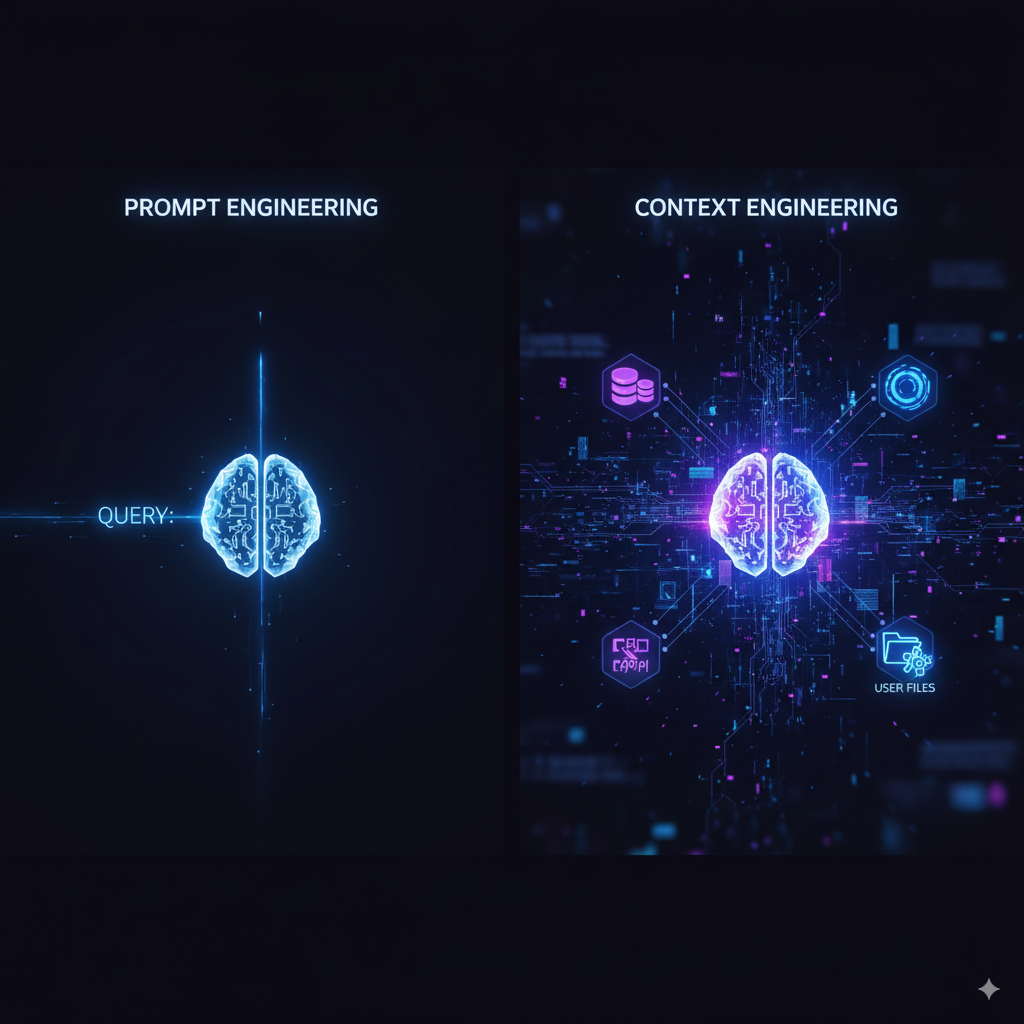
Prompt Engineering vs. Context Engineering: The Evolution You Need to Know
Most no-code builders and automation enthusiasts are intimately familiar with prompt engineering—the art of crafting the perfect question or instruction to get a desired output from an AI. It's an essential skill, teaching us how to communicate effectively with large language models (LLMs). But as AI systems become more integrated and complex, a new, more powerful discipline is emerging: context engineering. This isn't just about what you ask, but the entire information environment you build for the AI to operate within. It's the next-level thinking required to create truly robust and reliable AI systems.
What is Prompt Engineering?
At its core, prompt engineering is the craft of designing a specific input—a prompt—to elicit a precise, desired output from an LLM. Think of it like this: you have a brilliant but somewhat forgetful intern. Prompt engineering is like asking that intern a single, perfectly-worded question to get a specific answer right now. You formulate your request, perhaps specify the tone, format, or length, and the AI provides a response based solely on that immediate instruction and its inherent knowledge.
While incredibly important for interacting with AI, prompt engineering often functions as a one-off interaction. It's reactive, designed for an immediate task, and inherently lacks long-term memory or access to external, dynamic knowledge beyond what you provide in that single prompt.
What is Context Engineering?
Context engineering represents a significant evolution. It moves beyond the isolated prompt to focus on building the entire information environment in which the AI operates. Instead of just asking our brilliant intern a question, you're equipping them with everything they need to consistently perform well on complex tasks.
Imagine giving your intern the question, but also providing them with:
- Relevant customer files: Like access to a database or a Retrieval-Augmented Generation (RAG) system that pulls in specific documents.
- The company's official style guide: Ensuring all communications are on-brand and consistent.
- Examples of past successful reports: Guiding the AI on best practices and desired output quality.
- Permission and tools: Allowing them to use a calculator for calculations or a web search API for up-to-the-minute information.
In essence, context engineering is about designing the whole system, configuring the AI's "workspace" so it has all the necessary background, instructions, tools, and data to consistently perform, even on nuanced and multi-faceted challenges. It shifts the focus from optimizing a single 'prompt string' to designing a comprehensive 'system'.
Key Differences Summarized
To put it simply:
- Scope: Prompt Engineering is micro—focused on a single input and an immediate response. Context Engineering is macro—concerned with the entire system and consistent, reliable performance over time.
- Goal: Prompt Engineering aims for a great immediate output. Context Engineering aims for a reliable, repeatable process and high-quality outputs across a range of tasks.
- Analogy: Prompting is like asking a specific question. Contexting is like building the entire, well-equipped workspace for the person you're asking, ensuring they have everything at their fingertips to answer correctly and thoroughly every time.
Why This Matters for No-Code/Low-Code Builders
For no-code and low-code builders, understanding context engineering isn't just theoretical—you're likely already practicing it without realizing its full scope. When you:
- Build a multi-step workflow in Zapier or Make.com that chains together AI actions, feeds previous results into subsequent steps, and includes tools like data parsers or webhooks—you are creating context.
- Create a Custom GPT (or similar AI agent) with specific instructions and uploaded documents (your company's knowledge base, product specs, etc.)—you are actively defining its operational context.
- Integrate an LLM with a database or CRM to pull personalized information before generating a response—you are building context.
This reframes your existing skills. You're not just a prompt engineer; you're an architect of AI environments. You're designing the 'system' that allows the AI to move beyond one-off answers to become a truly integrated and reliable part of your automated workflows.
Conclusion
Prompt engineering is far from obsolete; it remains a vital component and the foundational skill for interacting with AI. However, it is now part of the much broader and more powerful discipline of context engineering. For anyone serious about building efficient, reliable, and scalable AI-powered solutions in the no-code/low-code space, mastering how to build and manage context is the absolute key to unlocking the next level of performance, consistency, and automation power. It's about empowering your AI to not just answer questions, but to truly understand and operate within the world you define for it.